Most application security programs are built on a combination of SAST and DAST. SAST analyzes source code before it runs. DAST probes the running application from the outside. Together they catch a meaningful range of issues, integrate cleanly into CI/CD pipelines, and run without requiring human coordination.
What they do not do is replace penetration testing. And what traditional penetration testing cannot do, at the pace modern development demands, is operate continuously. That is the gap agentic pentesting was built to close.
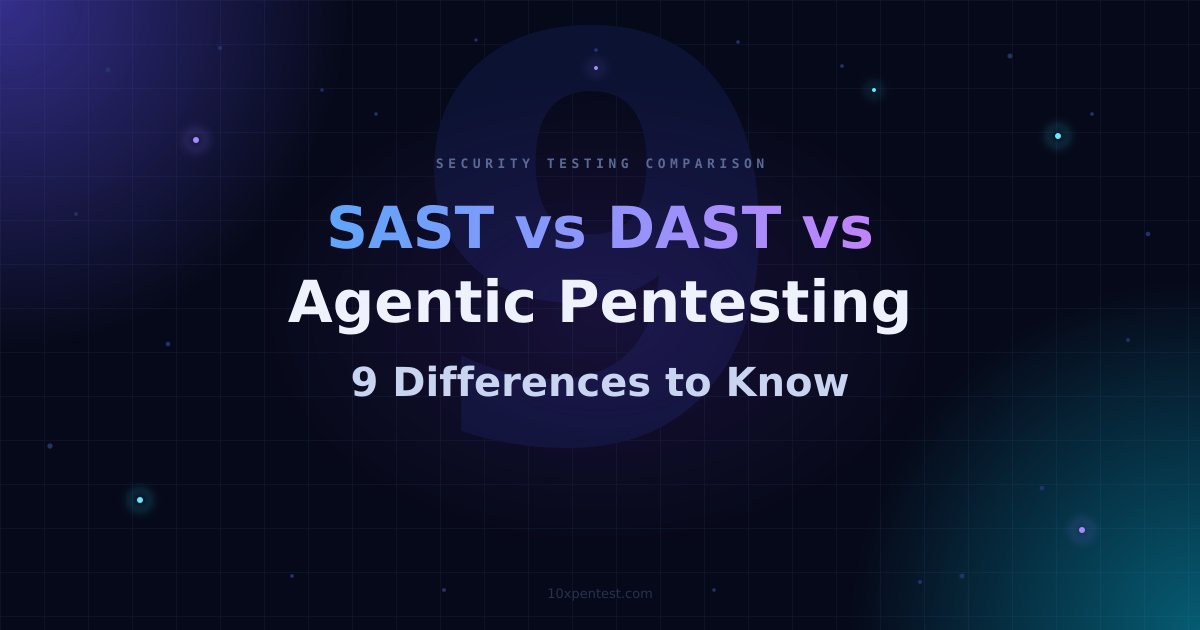
Understanding where each tool sits, what it actually tests, and what it fundamentally cannot reach is the foundation of a security program that has real coverage rather than apparent coverage. These nine differences frame exactly that distinction.
Before the differences, a crisp definition of each.
SAST (Static Application Security Testing) analyzes source code, bytecode, or binary without executing the application. It runs at build time, requires access to the codebase, and catches code-level issues: hardcoded secrets, insecure function calls, missing input sanitization in the source, dependency vulnerabilities. It has no view of runtime behavior.
DAST (Dynamic Application Security Testing) probes a running application from the outside, the same way a browser or HTTP client would. It fires payloads at discovered endpoints, observes responses, and flags matches against known vulnerability signatures. It requires no source code access but has no view of code structure or logic.
Agentic pentesting deploys AI agents that reason through attack paths the way a skilled human tester would, at scale and speed no human team can match. Agents adapt in real time to what the application reveals, chain findings across components, and prove exploitability before reporting. It tests the full application from an attacker's perspective, covering what both SAST and DAST structurally cannot reach.
The 9 key differences
SAST runs early, at the code level, before the application is built or deployed. It is the security check closest to the developer, ideally integrated into the IDE or pre-commit hooks so issues are caught before they leave the workstation.
DAST runs against a deployed or staged application. It cannot operate until there is a running target, which means it sits later in the pipeline, typically in CI against a test environment or staging against a deployed build.
Agentic pentesting runs against the production application or a full staging environment. Like DAST, it requires a running target. Unlike DAST, it can operate continuously in production with safe exploitation controls, covering the actual environment that attackers would target rather than a test approximation. The 10x Pentest platform is built for continuous production-safe testing precisely because the production surface is what matters.
Difference 2: Access requirements
SAST requires access to source code, bytecode, or binaries. It is an inside-out tool: it reads the application's construction to find flaws in how it was written.
DAST requires only a URL and credentials if the tested surface includes authenticated endpoints. No source code access, no SDK integration, no agent installation. It is an outside-in tool.
Agentic pentesting also requires only a URL and defined scope. No source code, no VPN, no network access to internal infrastructure. This matters operationally: third-party security testing without source code access is often a compliance requirement for regulated industries, and both DAST and agentic pentesting satisfy it where SAST does not.
Difference 3: What vulnerability classes each finds
This is the dimension that matters most for security teams deciding which tools to run.
SAST finds code-level issues that exist regardless of runtime behavior: hardcoded credentials, use of deprecated cryptographic functions, unsafe deserialization patterns, SQL query construction from unvalidated input in the source, dependency versions with known CVEs. These are valuable catches, but they are limited to what is visible in the code.
DAST finds runtime issues that only manifest when the application is executing: reflected and stored XSS in accessible input points, SQL injection in GET and POST parameters, insecure HTTP response headers, cookie configuration issues, and some classes of information disclosure. These are the surface-level issues that no amount of code review would necessarily reveal because they depend on the runtime environment.
Agentic pentesting covers what both miss: business logic violations that require understanding application intent, broken access control and IDOR requiring multi-user context modeling, race conditions in transaction and session handling, chained attack paths connecting multiple components, authenticated application surfaces requiring complex session state navigation, and second-order injection where the payload is stored and executed in a different context. These are the vulnerability classes that appear most frequently in serious security incidents and most consistently escape both SAST and DAST coverage.
Difference 4: False positive rates
SAST false positive rates are structurally high. Code patterns that look dangerous in static analysis are often benign in context: a function that constructs a SQL query from a string may be doing so safely because the string is validated upstream in a way the static analyzer cannot trace. Security teams working with SAST output spend significant time triaging findings that turn out to be non-issues.
DAST false positive rates vary by tool but arise from the same structural cause: signature matching against runtime responses will flag conditions that are not actually exploitable in the specific application context.
Agentic pentesting is built to eliminate false positives at the architecture level. A finding is not reported until exploitation is proven. SQL injection is not flagged until data is extracted. Authentication bypass is not reported until unauthorized access is demonstrated. The finding list is short and confirmed, which means remediation time goes toward fixing real issues rather than investigating maybes.
Difference 5: Ability to test authenticated surfaces
SAST has no concept of authentication. It analyzes code regardless of how the application controls access.
DAST can be given credentials but has limited ability to navigate complex authenticated state. Multi-step workflows with required field sequences, role-based interfaces that present different options to different users, and stateful flows that change available actions based on prior steps are difficult for DAST to traverse reliably. Large portions of authenticated application surfaces go untested as a result.
Agentic pentesting maintains full authenticated session state simultaneously across multiple user roles. It maps what each role can access, navigates complex multi-step flows, and systematically tests whether authorization boundaries between roles are enforced. The difference between DAST's authenticated coverage and agentic coverage is the difference between testing the login page and testing what happens after login, across every role and permission boundary.
Difference 6: Business logic awareness
SAST has no model of business logic. It analyzes code structure, not intent.
DAST has no model of business logic. It matches payloads against responses without understanding what the application is supposed to do.
Agentic pentesting is the only approach of the three that tests intent violations. Applying a discount code twice by manipulating request order, skipping a required approval step in a multi-stage workflow, triggering a credit instead of a charge by submitting a negative quantity, these require understanding the application's intended behavior and then testing systematically whether that intent is enforced. As described in the agentic pentesting overview, this reasoning layer is what separates agentic systems from both SAST and DAST structurally, not just by degree.
Difference 7: Attack chain discovery
SAST finds issues in isolation within specific code paths. It does not reason about how a flaw in one component connects to a flaw in another.
DAST tests each endpoint independently. There is no mechanism for connecting a finding on one endpoint to a finding on another into a full attack narrative.
Agentic pentesting carries context across the entire assessment. When it discovers an information disclosure on a public endpoint, it uses that information to target authenticated endpoints. When it finds a low-severity misconfiguration, it tests whether that misconfiguration can be combined with an authorization gap to produce a high-severity outcome. The final report includes not just individual findings but the attack paths that connect them, which is the kind of thinking that determines real-world breach impact.
SAST can run on every commit and flag whether a previously identified pattern has been addressed in the code. This is one of its genuine strengths: fast feedback on code-level fixes.
DAST can rerun against a deployed environment and confirm whether a previously found issue is still present. The challenge is scheduling: automated DAST retests depend on pipeline triggers and deployment cadence.
Agentic pentesting retests automatically when a fix is deployed. The specific finding is retested the same day and confirmed closed or still open. This is operationally significant for security teams managing remediation SLAs: the loop between fix deployment and fix validation closes continuously rather than waiting for the next scan cycle or, in the case of traditional pentesting, the next engagement. The autonomous pentesting model is built around this continuous validation loop.
Difference 9: Compliance evidence quality
SAST produces a list of code-level findings at a point in time. It demonstrates that code was analyzed, not that the running application is secure.
DAST produces a point-in-time report of runtime issues found during a scan window. It demonstrates that the application was probed, not that it was thoroughly assessed.
Agentic pentesting produces a continuous evidence record: timestamped findings, exploitability proof, and automatic remediation confirmation across every assessment run. For compliance frameworks including SOC 2, ISO 27001, PCI DSS, and HIPAA, this continuous record is increasingly what auditors ask for. A running log of confirmed findings and confirmed remediations tells a more complete security story than either a static code analysis report or a periodic scan summary.
Side-by-side comparison
| Dimension | SAST | DAST | Agentic Pentesting |
|---|
| When it runs | Build time / pre-commit | Deployed / staging | Continuous / production-safe |
| Source code required | Yes | No | No |
| Authentication testing | No | Partial | Full multi-role |
| Business logic | No | No | Yes |
| Chained attack paths | No | No | Yes |
| Race conditions | No | No | Yes |
| IDOR / access control | Limited | Limited | Full |
| False positive rate | High | Moderate | Low (exploitation proven) |
| Auto-retest after fix | Yes (code pattern) | Partial | Yes (same day) |
| Compliance evidence | Code scan report | Point-in-time scan | Continuous record |
| Setup time | Requires code access | URL + credentials | URL + scope |
How they fit together
The right mental model is not "which one replaces the others." It is "which layer of the security program does each one cover."
SAST belongs in the development layer: in the IDE, in pre-commit hooks, in the build pipeline. It catches code-level issues the moment they are written, where they are cheapest to fix. For finding hardcoded secrets, insecure dependencies, and dangerous coding patterns before code leaves the developer's machine, nothing is faster or cheaper.
DAST belongs in the CI/CD layer: running against every build in a test or staging environment, catching surface-level runtime issues before they ship. For catching XSS in new input fields, SQL injection in new parameters, and header misconfigurations in every deployment, DAST adds value that complements SAST without replacing it.
Agentic pentesting belongs as the continuous security validation layer: running against the full production application surface, finding what both SAST and DAST miss, proving exploitability on every finding, and automatically retesting after remediation. For organizations that want to know their actual security posture rather than the posture of their code or their surface-level runtime behavior, agentic pentesting covers the ground neither of the other tools reaches.
Running all three is the security stack that reflects how modern applications are actually attacked. See what continuous agentic coverage looks like for your team at the 10x Pentest platform page, review pricing for your scale, or get in touch to talk through how to fit agentic testing into your existing SAST and DAST program.
Frequently asked questions
1. What is the main difference between SAST and DAST?
SAST analyzes source code without running it, finding issues in how the application was written. DAST probes the running application from the outside, finding issues in how it behaves at runtime. SAST requires code access and runs early in the development lifecycle. DAST requires no code access and runs against deployed applications. They catch different vulnerability classes: SAST finds code-level flaws like insecure function calls and hardcoded secrets; DAST finds runtime-exposed issues like reflected XSS and SQL injection in accessible parameters. Most security programs benefit from running both, as they cover largely non-overlapping ground.
2. Does SAST or DAST replace penetration testing?
Neither replaces penetration testing. SAST and DAST each cover specific, bounded categories of vulnerabilities that can be detected automatically. Penetration testing, whether human-led or agentic, covers the vulnerability classes that require reasoning: business logic violations, chained attack paths, race conditions, broken access control requiring multi-user context, and complex authentication bypass sequences. A clean SAST and DAST report means no known code-level patterns were found and no surface-level signature matches were returned. It does not mean the application is secure against an attacker who reasons about it.
3. When should I use SAST vs DAST vs agentic pentesting?
Use SAST in your development environment and pre-commit pipeline to catch code-level issues the moment they are written. Use DAST in CI/CD against every build to catch surface-level runtime regressions before they ship. Use agentic pentesting continuously against the full production application surface to find business logic flaws, chained attack paths, authorization gaps, and the vulnerability classes that SAST and DAST structurally cannot reach. These are not competing tools. They cover different layers of the same application and are most effective when run together.
4. What does IAST add to SAST and DAST?
Interactive Application Security Testing (IAST) instruments the application at runtime, inserting sensors into the code execution path to monitor behavior from the inside while the application runs. It combines aspects of both SAST (code-level visibility) and DAST (runtime observation) and can produce lower false positive rates than either in isolation. However, IAST requires agent installation and application instrumentation, which adds deployment complexity, and it still does not cover business logic, chained attack paths, or multi-user context modeling. The addition of agentic pentesting covers the ground IAST also misses.
5. How does agentic pentesting fit into a DevSecOps pipeline?
Agentic pentesting integrates into DevSecOps by triggering on deployment events, running against the updated application surface, and surfacing findings before the next release cycle. Unlike SAST and DAST which run on every build, agentic pentesting runs at a cadence matched to deployment milestones and provides the deep security validation layer that pipeline-integrated scanning cannot replicate. The combination of SAST in the pre-commit stage, DAST in CI, and agentic pentesting triggered on deployment gives DevSecOps programs coverage across the full security testing lifecycle without requiring manual coordination at any stage.


 Tejas Dhokane Oct 22, 2026