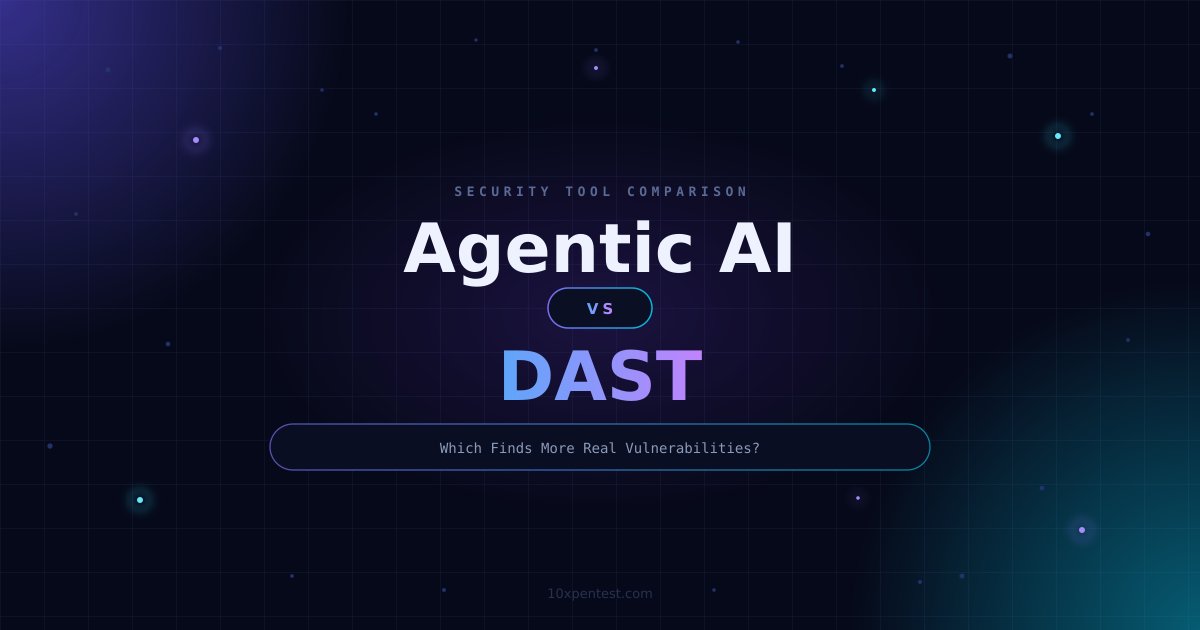
DAST has been a fixture in application security programs for over a decade. It runs automatically, integrates into CI/CD pipelines, and covers ground quickly. For teams trying to add some security validation without slowing down delivery, it checks a lot of boxes.
But security teams working at the vulnerability level know that DAST and "finds real vulnerabilities" are not always the same sentence. DAST finds a specific category of issues well, and misses significant others entirely. That gap is not a DAST failure per se; it is a category limitation. Understanding it is what determines whether your security program has genuine coverage or a false sense of it.
Agentic AI pentesting is built to close that gap. The question worth answering is exactly where each tool finds real issues, where each falls short, and what the practical difference looks like for a security team trying to ship secure software continuously.
What DAST actually does
Dynamic application security testing (DAST) works by probing a running application from the outside, the same way a browser or HTTP client would. It fires predefined payloads at discovered endpoints, observes responses, and flags anomalies that match known vulnerability signatures.
DAST tools are fast, require no access to source code, and can run in automated pipelines without human intervention. For classes of vulnerability that manifest through straightforward input and response patterns, they perform well. SQL injection via GET parameters, reflected XSS in form fields, server headers that leak version information, missing security headers, these are categories where DAST reliably finds real issues.
The limitation is in how DAST reaches its conclusions. It is pattern matching at scale, not reasoning. It sends payload A, receives response B, compares B against a library of known-bad signatures, and reports a match. That workflow works for surface-level issues but breaks down anywhere the vulnerability requires context, state, or multi-step reasoning to surface.
Where DAST consistently falls short
The categories DAST misses are not edge cases. They represent a substantial portion of the vulnerabilities that show up in real pentest engagements.
Authentication and session logic. DAST can test whether a login form accepts weak passwords or whether session cookies have the right flags set. It cannot reason about what happens when session tokens are predictable, when the token rotation logic has a race condition, or when password reset flows can be abused for account takeover through a four-step sequence. These require understanding the application's intended behavior and then testing deviations from it.
Authorization flaws and IDOR. Insecure direct object references and broken access control are among the most common high-severity findings in manual pentests. DAST tools struggle here because identifying an IDOR requires knowing that resource ID 1042 belongs to user A, then confirming that user B can access it. Without session context and multi-user reasoning, DAST cannot model that scenario.
Business logic vulnerabilities. DAST has no model of what an application is supposed to do. It cannot identify that skipping step 2 of a checkout flow lets you apply a discount code twice, or that manipulating a quantity parameter to a negative value triggers a credit instead of a charge. These findings require understanding intent, and intent is not in a payload library.
Chained vulnerabilities. Real-world breaches rarely hinge on a single flaw. They chain a low-severity information disclosure into a medium-severity authentication weakness into a high-severity privilege escalation. DAST tests each endpoint in isolation and has no mechanism for connecting findings across a session into a full attack path.
Authenticated application surfaces. DAST can be given credentials, but its ability to navigate authenticated application state is limited. Complex multi-step flows, role-based interfaces, and stateful workflows are difficult for DAST to traverse reliably. Large portions of many applications go untested as a result.
What agentic AI pentesting does differently
Agentic AI pentesting is not automated scanning with a new label. The difference is in the reasoning layer.
When 10x Pentest runs an assessment, more than 75 specialized agents work in parallel across different security domains: authentication, authorization, input validation, session management, business logic, and more. Each agent is trained on a decade of real engagement data, not on theoretical vulnerability catalogs. They do not fire payloads and match signatures. They observe how the application responds, adapt their approach based on what they learn, and chain findings together the way a skilled human tester would.
The practical difference shows up immediately in what gets reported. A DAST tool will flag a reflected XSS in an input field. An agentic system will find the same XSS, then continue reasoning: is this input field reachable by another user? Can the payload survive CSP? Can it be used to steal session tokens that are not marked HttpOnly? The final finding is not "reflected XSS exists" but "reflected XSS in field X is exploitable for session hijacking via this specific chain."
That standard, proving exploitability rather than flagging potential issues, is the same standard a human pentester holds themselves to. It is also what makes the difference between a finding that gets triaged for six weeks and one that gets fixed immediately. You can see how the 10x Pentest platform structures this across its agent architecture.
The false positive problem
DAST false positive rates vary widely by tool and target, but the underlying cause is structural. When a tool matches a response against a signature library, it will inevitably flag things that are not actually exploitable in context. Security teams learn quickly that a DAST report is a starting point, not a finding list. Triaging the noise takes time.
Agentic pentesting addresses this at the architecture level. A vulnerability is not reported until exploitation is demonstrated. SQL injection is not flagged until data is actually extracted. An authentication bypass is not in the report until unauthorized access is confirmed. The findings that reach the security team are proven, which means engineering time goes toward fixing real issues rather than investigating maybes.
That difference compounds over time. A team running continuous agentic testing builds a muscle for fixing confirmed vulnerabilities quickly. A team running DAST builds a muscle for triaging uncertain findings, which is a different and less productive habit.
Where DAST still belongs
None of this means DAST has no place in a modern security program. It does, and it is worth being precise about what that place is.
DAST is fast, cheap to run continuously, and catches a reliable class of surface-level vulnerabilities well. For catching regressions in known vulnerability classes across every build, it adds genuine value. It also integrates cleanly into pipelines where speed matters more than depth, such as pre-commit hooks or early CI stages where catching obvious issues quickly is the goal.
The mistake is treating DAST output as equivalent to a security assessment. It is not. It covers one layer of the application surface, catches one category of issues, and has no visibility into the reasoning layers where the most impactful vulnerabilities typically live. Security teams that understand this use DAST as one signal among several, not as a coverage story.
The practical answer for most engineering organizations is: use DAST for fast, automated detection of surface-level regressions in the pipeline, and use agentic pentesting for genuine coverage of the full attack surface including authentication logic, authorization models, business logic, and exploit chains. They are not competing for the same job. As discussed in the context of agentic pentesting and continuous security validation, the shift toward continuous, exploit-driven testing does not eliminate automated scanning; it defines what each tool is actually for.
SAST, DAST, and agentic pentesting: how they fit together
The "SAST vs DAST vs penetration testing" question comes up frequently, and the framing matters. These are not competing tools fighting for the same slot in the security budget. They test different things and belong at different points in the development lifecycle.
SAST (static application security testing) analyzes source code before runtime. It catches code-level issues early and cheaply: hardcoded secrets, insecure function calls, missing input sanitization in the source. It has no view of runtime behavior.
DAST tests the running application from outside. It catches surface-level runtime issues that SAST cannot see: HTTP response handling, live injection points, server configuration. It has no view of code or logic.
Agentic pentesting tests the full application from an attacker's perspective, at runtime, with full reasoning capability. It covers what both SAST and DAST miss: multi-step attack chains, business logic violations, authorization flaws, and complex authentication bypasses. It does not replace SAST or DAST for their specific jobs; it covers the ground neither of them reaches.
Most mature security programs end up running all three. SAST in the IDE and pre-commit. DAST in CI. Agentic pentesting continuously against the full application surface, with findings that feed directly into sprint planning. You can explore how this works in practice on the autonomous pentesting overview or check pricing to see what continuous agentic coverage costs for your team size.
Frequently asked questions
1. Can DAST replace penetration testing?
No. DAST and penetration testing test different things. DAST fires automated payloads at HTTP-accessible surfaces and flags signature matches. Penetration testing, whether human-led or agentic, involves reasoning about the application's logic, chaining findings across components, and proving exploitability. The classes of vulnerability that cause the most significant breaches, authorization flaws, business logic bugs, chained attack paths, are largely invisible to DAST. Teams that rely on DAST alone have meaningful coverage gaps even when their DAST report comes back clean.
2. Does agentic AI pentesting integrate with CI/CD the way DAST does?
Yes. Agentic pentesting can run continuously and trigger on deployment events the same way DAST does. The difference is depth, not integration model. Both can run automatically without human coordination; agentic testing just finds a substantially broader category of vulnerabilities when it does.
3. What vulnerability classes does DAST find well?
DAST reliably catches reflected and stored XSS in accessible input points, SQL injection in GET and POST parameters, server misconfiguration, missing security headers, insecure cookie flags, and some classes of information disclosure. For these surface-level issues, a well-configured DAST tool performs consistently.
4. What does DAST consistently miss?
Business logic flaws, insecure direct object references and IDOR vulnerabilities, multi-step authentication bypasses, race conditions in session or transaction handling, chained attack paths that require connecting findings across components, and vulnerability classes that only manifest in authenticated application state that DAST cannot navigate. These are exactly the issues that show up most frequently in serious security incidents.
5. How much does agentic pentesting cost compared to running a DAST tool?
DAST tools range from open-source options that are free to run to commercial products at varying price points. Agentic pentesting is more expensive than a free DAST scanner, but significantly less expensive than a traditional manual pentest engagement, which typically runs $15,000 to $80,000 per assessment. The more relevant comparison is coverage per dollar: agentic pentesting finds the classes of vulnerabilities that matter most, at a cadence that DAST alone cannot achieve. See 10x Pentest pricing for specifics, or get in touch to talk through what continuous coverage looks like for your stack.


 Tejas Dhokane Oct 22, 2026