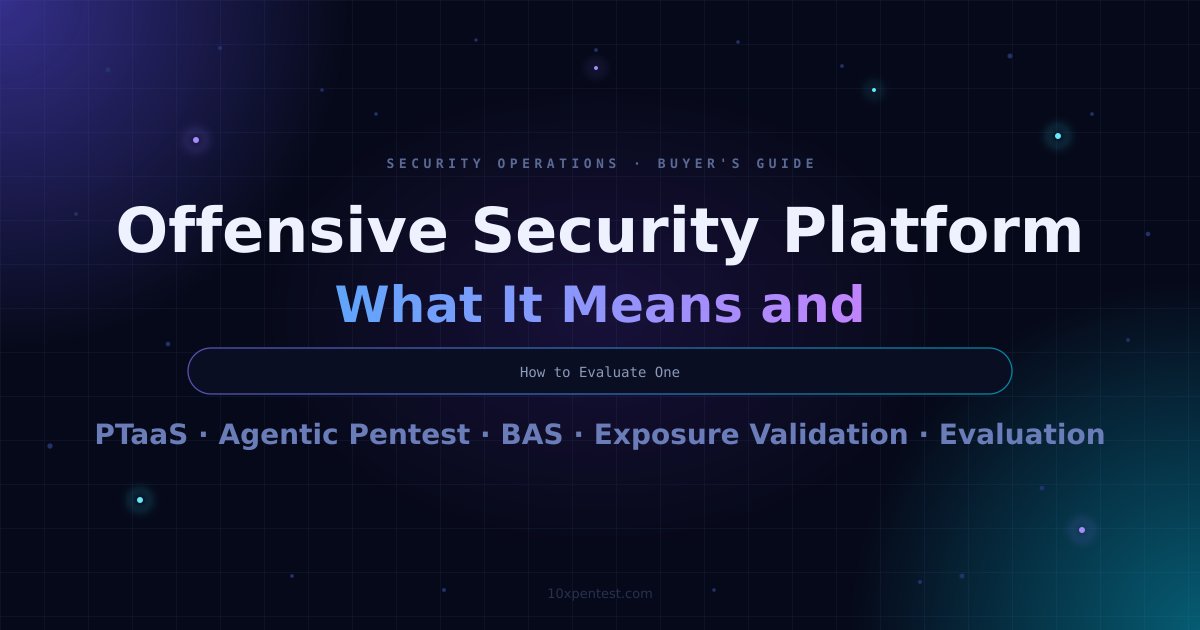
"Offensive security platform" is a commercial category being defined in real time. Three years ago, it meant Kali Linux, Metasploit, and Burp Suite: tools for practitioners. Today, vendors are using it to describe subscription platforms that deliver continuous security validation, automated exploitation, breach simulation, or agentic penetration testing as a managed service. The same phrase covers products with meaningfully different capabilities, different threat models, and different operational requirements.
Buyers evaluating platforms in this category face a consistent problem: the category name tells them what the vendor wants to be, not what the platform actually does. Understanding the four distinct product types that "offensive security platform" currently describes, what each delivers, where each falls short, and what evaluation criteria separate them is the prerequisite for making a purchase decision that solves the actual security problem.
What offensive security means
Offensive security is the practice of adopting the attacker's perspective to find and validate security weaknesses before real attackers do. It is the complement to defensive security (detection, response, hardening) and operates on the logic that the most reliable way to know whether your defences work is to test them against realistic attack techniques.
The offensive security discipline includes penetration testing, red teaming, vulnerability research, bug bounty programs, and increasingly, continuous automated security validation. What separates offensive security from defensive security is the direction of the work: offensive security acts like an attacker to find gaps; defensive security builds and monitors the controls that prevent and detect attacker activity.
Type 1: PTaaS (Penetration Testing as a Service)
PTaaS platforms deliver penetration testing through a software interface rather than a purely professional services model. The buyer defines scope, testers conduct the engagement, and findings are delivered through a dashboard rather than a PDF report. Retesting is managed through the same interface. Some PTaaS platforms blend human testers with automated tooling.
What PTaaS delivers: managed engagement delivery, centralised finding tracking, faster remediation cycles than traditional engagement-and-report models, and sometimes continuous coverage through automated components between human-led assessments.
What PTaaS does not deliver: PTaaS platforms that rely primarily on human testers do not provide continuous coverage. Engagements still have windows. Findings between windows are not detected.
Who it fits: organisations that want the depth and credential of human penetration testing with better operational workflow than the traditional PDF-and-spreadsheet model.
Type 2: Agentic continuous pentesting
Agentic platforms deploy AI agents that conduct the reasoning work of penetration testing autonomously and continuously, without human testers in the loop for each assessment. Agents observe application behavior, adapt their approach, prove exploitability before reporting, and retest after remediation automatically.
What agentic pentesting delivers: continuous coverage that matches deployment cadence, confirmed exploitable findings, business logic coverage, multi-role authorization testing, and automatic remediation validation. The agentic pentesting and continuous security validation model addresses what periodic human engagements structurally cannot: the detection gap between assessment windows.
What agentic pentesting does not deliver: for highly novel attack chains requiring specific domain expertise and sustained campaign design, human judgment retains an edge. Agentic platforms are the systematic continuous layer, not a substitute for every scenario that benefits from human expertise.
Who it fits: organisations shipping software continuously where annual or quarterly manual testing leaves unvalidated deployments between assessment cycles. Also: organisations managing multiple applications where per-engagement pricing scales linearly with application count.
Type 3: Breach and attack simulation (BAS)
BAS platforms simulate known attack techniques against an organisation's defensive controls to test whether those controls detect and block what they are supposed to. BAS runs a library of attack scenarios against SIEM detection rules, EDR behavior, email filtering, and network controls, then reports which scenarios were detected and which were not.
What BAS delivers: continuous validation that defensive controls are working as configured, detection gap identification, and a prioritised list of detection rule improvements. BAS is optimised for testing the detection layer.
What BAS does not deliver: BAS simulates attack techniques against defensive controls. It does not find vulnerabilities in applications, APIs, or business logic. It tests whether your SIEM would detect a known attack pattern, not whether your application contains exploitable vulnerabilities. BAS and penetration testing answer different questions.
Who it fits: organisations with mature security operations centres that want to continuously validate their detection and response capability, not organisations primarily trying to find application or network vulnerabilities.
Continuous Threat Exposure Management (CTEM) platforms combine attack surface discovery, vulnerability intelligence, asset prioritisation, and validation of exposure pathways into a continuous operational workflow. Some CTEM platforms include exploitation validation components; others focus primarily on discovery and prioritisation.
What CTEM delivers: a continuously updated picture of the full external attack surface with risk-prioritised remediation guidance, supply chain exposure visibility, and in some implementations, automated validation of whether discovered exposures are genuinely exploitable.
What CTEM does not deliver: CTEM platforms focused on discovery and prioritisation do not confirm exploitability in the way penetration testing does. They flag potential exposure; penetration testing proves actual risk. The attack surface management overview covers the full EASM and CTEM landscape in detail.
Who it fits: security teams managing large, complex external attack surfaces who need continuous inventory and prioritisation across a large asset inventory, as a complement to penetration testing rather than a substitute.
The five evaluation criteria that cut through vendor positioning
Criterion 1: What does it actually exploit, and can it prove it?
The most consequential question. "Offensive security" implies exploitation: active testing that demonstrates real impact. Platforms that conduct exposure discovery and vulnerability identification without confirming exploitability are defensive intelligence tools with an offensive label.
Ask: does the platform produce findings based on confirmed exploitation or on signature matching? For each finding it reports, can it show the specific request used, the specific response demonstrating impact, and the specific data or access demonstrated? A platform that cannot produce proof-of-exploitation evidence for each finding is not conducting offensive security in any technically meaningful sense.
This is the same criterion that separates genuine AI pentesting from AI-labeled scanners, addressed in detail in AI penetration testing: how it works and what to look for in a vendor.
Criterion 2: Does it cover business logic and authorization gaps?
Standard vulnerability scanning tools find signature-matched vulnerabilities. Offensive security platforms should find the vulnerability classes that require attacker reasoning: business logic flaws, multi-role authorization gaps, race conditions, and chained attack paths. The security gaps DAST and standard testing misses covers these ten categories specifically.
Ask the vendor: how does the platform test business logic vulnerabilities? What is its methodology for testing authorization across multiple user roles simultaneously? If the answer is vague or defaults to "our AI analyzes the application surface," you are looking at a scanner-layer product, not an offensive security platform.
Offensive security value is measured by security improvement, not finding count. An offensive security platform that produces findings without a clear path from finding to confirmed fix is producing a to-do list rather than driving security improvement.
Ask: how quickly does the platform retest after a fix is deployed? Is retesting automatic or scheduled? Does the retest produce specific evidence that the exploit path is closed, not just a "no findings" scan result? How autonomous pentesting works in a DevSecOps pipeline covers what same-day automatic remediation validation looks like operationally.
Criterion 4: What is the cadence model?
This determines whether the platform addresses the coverage gap that most security programs carry or merely automates what was already being done periodically.
A platform that schedules discrete engagement windows (even automated ones) does not provide continuous coverage. A platform that triggers assessment on deployment events covers the detection gap between human engagement windows. Continuous penetration testing and how it differs from annual pentests maps the cadence distinction that separates continuous coverage from high-frequency periodic assessment.
Criterion 5: Where does it fit in the security stack?
No offensive security platform addresses every security validation need. Red team exercises for detection capability testing, manual penetration testing for deeply domain-specific scenarios, and DAST in CI/CD for fast regression detection each serve distinct purposes that no single platform fully replaces.
Ask the vendor where their platform fits and where it does not. A vendor who claims their platform replaces everything else is either describing a genuinely comprehensive capability set or overselling. The right answer names what the platform does well and where it is supplemented by other tools. Red team vs. penetration testing: what's the real difference maps the boundaries between continuous automated testing and red team exercises specifically.
The offensive security vs defensive security distinction
Understanding the category requires understanding why offensive and defensive security are fundamentally different practices, not just different parts of the same program.
Defensive security builds and operates controls: firewalls, EDR, SIEM, identity governance, patch management. It answers the question: are our controls correctly configured and operating?
Offensive security tests those controls from the attacker's perspective: do the controls actually prevent what they are supposed to prevent? It answers the question: what would an attacker be able to do given our current security posture?
A purely defensive security program that never tests its own controls operates on the assumption that what is configured to work actually works. Offensive security replaces that assumption with evidence. An organisation running both discovers sooner whether their defensive investments are producing actual security.
How DAST compares to agentic AI pentesting covers the distinction between the automated defensive security testing layer (DAST) and offensive security testing in detail. AI in penetration testing: how automation is changing security testing covers the full landscape of AI-driven security testing and where each approach sits on the offensive-to-defensive spectrum.
The offensive security platform market currently has three pricing and capability tiers:
Tier 1: Managed PTaaS with automation assistance. Human testers conduct engagements through a platform interface. Automation assists with reconnaissance and reporting. Cost scales with engagement scope and frequency. Appropriate for organisations that want human expertise and are willing to pay for it, accepting periodic rather than continuous coverage.
Tier 2: Agentic continuous platforms. AI agents conduct continuous testing with human oversight for findings review and remediation guidance. Cost scales with application count and scope. Appropriate for organisations shipping continuously where periodic testing leaves unvalidated deployments and per-engagement pricing scales poorly with application portfolio size.
Tier 3: Full exposure validation suites. CTEM platforms combining ASM discovery, BAS for detection validation, and some exploitation validation in a single subscription. Cost scales with asset inventory size. Appropriate for large security teams managing extensive infrastructure who need a unified view of exposure, detection gaps, and application risk.
Most organisations begin with Tier 1 or Tier 2 and add components from Tier 3 as their security program matures. The mistake is treating Tier 3 as a substitute for Tier 1 or 2: exposure management without exploitation confirmation does not answer whether discovered exposure is genuinely at risk.
The 10x Pentest platform is a Tier 2 agentic continuous pentesting platform. More than 75 specialized agents conduct genuine penetration testing continuously against the defined scope: authentication, authorization, business logic, APIs, session management, and input validation. Every finding includes proof-of-exploitation evidence. Retesting is automatic after remediation. Coverage runs on every deployment, not on a fixed calendar.
For penetration testing services in the US, PTaaS for continuous coverage, or agentic penetration testing, see pricing for what continuous offensive security coverage costs at your scale, or get in touch to discuss how the platform fits your specific security program and application portfolio.
Frequently asked questions
Q1. What is an offensive security platform?
An offensive security platform is a commercial product that delivers security testing from the attacker's perspective, typically through a software-defined subscription model rather than purely professional services. The category currently encompasses four distinct product types: PTaaS (managed penetration testing through a software interface), agentic continuous pentesting (AI agents conducting autonomous penetration testing continuously), breach and attack simulation (automated testing of defensive control effectiveness), and continuous exposure management platforms (CTEM, combining attack surface discovery with exposure prioritisation). Each type addresses a different security validation need, and the category label alone does not indicate which type a specific product is.
Q2. How does an offensive security platform differ from traditional penetration testing?
Traditional penetration testing is a time-bounded professional services engagement where human testers conduct a scoped assessment and deliver a PDF report. An offensive security platform typically delivers testing through software infrastructure, enabling continuous or more frequent testing, centralised finding management, integrated remediation tracking, and in the case of agentic platforms, automated testing that runs without engagement scheduling. The key difference is operational model: traditional testing produces a periodic snapshot; a continuous offensive security platform produces ongoing security validation aligned to deployment cadence.
Q3. What is the difference between BAS and penetration testing?
Breach and attack simulation tests whether your defensive controls (SIEM, EDR, email filtering, network controls) detect and block known attack techniques. It validates your detection capability by running attack scenarios against your security tools. Penetration testing finds vulnerabilities in your applications, APIs, and network infrastructure that an attacker could exploit. BAS answers: would we detect this attack? Penetration testing answers: is this vulnerability actually exploitable? Both are offensive security practices but they address fundamentally different questions, and neither substitutes for the other.
Q4. What should an offensive security platform actually prove?
A genuine offensive security platform should prove exploitability for every finding it reports. It should produce the specific request used to exploit the vulnerability, the specific response demonstrating impact, and in the case of data access, the specific data accessed. Platforms that report findings based on signature matching or vulnerability intelligence without confirming exploitation are exposure management tools rather than offensive security platforms. The proof-of-exploitation standard is the single most important distinction between platforms in this category.
Q5. How do you evaluate whether an offensive security platform covers business logic?
Ask the vendor directly: how does your platform test multi-step workflow integrity? How does it test whether a checkout flow allows duplicate discount application? How does it test authorization enforcement between different user roles simultaneously? Platforms with genuine business logic coverage can describe specific test methodologies for these scenarios. Platforms that rely on signature-based detection cannot test business logic because business logic vulnerabilities have no signatures. The answer to this question reliably separates genuine offensive security platforms from scanning tools with offensive branding.

 Tejas Dhokane Oct 9, 2026