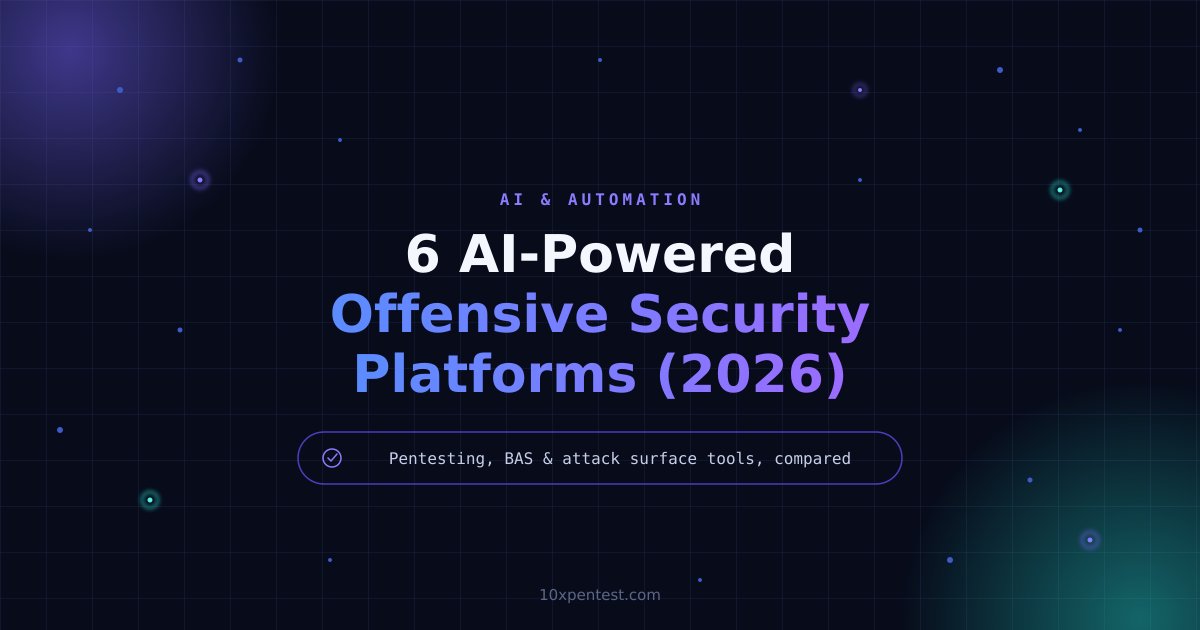
AI is changing offensive security fast, but the category is getting muddier, not clearer. "AI pentesting platform" gets used as a catch-all for tools that actually do very different jobs: some run genuine exploit-driven pentests, some simulate attacks to test detection, and some just map what's exposed to the internet. Treating them as interchangeable makes it harder to pick the right one.
Before the list, it's worth separating the categories:
- AI pentesting (like agentic pentesting): AI agents actively exploit vulnerabilities to prove they're real, the same goal as a traditional pentest, just automated.
- Breach and attack simulation (BAS): simulates attack scenarios on a schedule to test whether your existing detection and response tooling catches them. It's testing your defenses, not hunting for new holes.
- Attack surface management (ASM): continuously discovers and maps what's internet-facing, often with some red-team-style validation layered on, but the core job is visibility into exposure, not exploitation.
- Control validation: tests whether specific security controls work as configured, usually mapped to a framework like MITRE ATT&CK.
With that in mind, here are six platforms making an impact in the US market, grouped by what they actually do.
AI pentesting
1. 10x Pentest
10x Pentest runs more than 75 specialized AI agents in parallel, each one hunting for real, exploitable vulnerabilities the way a skilled human tester would, just at a scale no single person could match. The result is a full security assessment in hours instead of the week or more a traditional engagement typically takes.
Key features:
- AI-powered, agentic penetration testing workflows built on a decade of real pentest engagements
- Rapid deployment with minimal setup
- Exploit-driven findings, not just vulnerability lists
- Autonomous retesting to confirm fixes actually hold
- Detailed reporting with severity sorting and remediation guidance
Why it stands out: Most automated tools are good at finding theoretical issues and bad at telling you which ones matter. 10x Pentest is built around the opposite priority: proving exploitability and chaining weaknesses the way an actual attacker would, so security teams get a short list of real findings instead of a long list of maybes. That focus, combined with the speed of automation, is what makes continuous testing realistic for teams that could never justify a traditional pentest every sprint. You can see how the platform is structured, or check pricing to see what a continuous testing model costs compared to periodic engagements.
2. Horizon3.ai (NodeZero)
Horizon3.ai's NodeZero platform pairs autonomous penetration testing with AI-driven vulnerability assessment, with a deliberate focus on exploitability over raw vulnerability counts. Teams can run tests on demand and repeat them continuously to verify that fixes actually close the gap.
Key features:
- Autonomous, on-demand pentesting that can run continuously
- AI-driven analysis of attack paths and lateral movement
- Safe exploitation testing designed for production environments
- Remediation guidance backed by proof-of-concept exploits
Why it's notable: NodeZero's focus on chaining vulnerabilities into full attack paths, rather than reporting them in isolation, mirrors the kind of thinking human pentesters are trained to do. That approach has driven strong enterprise adoption, including in regulated industries where proof of exploitability carries real weight.
3. Pentera
Pentera sits close to the pentesting category but describes its own approach as automated security validation rather than a like-for-like replacement of manual-style testing. It uses AI to simulate real-world attacker tactics, techniques, and procedures (TTPs) across networks, cloud environments, and endpoints, giving teams a continuous read on exposure rather than a point-in-time snapshot.
Key features:
- Automated attack simulation across network, cloud, and endpoint surfaces
- Vulnerability prioritization based on actual exploitability, not just CVSS score
- Integration with existing security tools and SIEM platforms
- Safe exploitation designed not to disrupt production systems
Why it's notable: Pentera doesn't stop at scanning, it exploits findings in a controlled way, which gives security teams a clearer signal on which weaknesses genuinely pose risk. Its ability to adapt attack strategy to the target environment makes it a common fit for complex enterprise networks.
Breach and attack simulation (BAS)
4. Cymulate
Cymulate is a BAS platform first and foremost. It uses AI to continuously run an organization's environment through a large library of attack scenarios, from phishing to lateral movement, primarily to test whether existing defenses catch them.
Key features:
- Automated simulation across thousands of attack vectors
- AI-driven threat intelligence integration
- Actionable remediation guidance
- Coverage across email, web gateways, endpoints, and WAFs
Why it's notable: Cymulate's breadth of scenario coverage and relatively low setup overhead make it approachable for teams that want to validate detection and response without heavy configuration. It answers "would we catch this?" rather than "what can an attacker actually exploit right now?", which is the core distinction from a pentesting platform.
5. AttackIQ
AttackIQ is primarily a control validation platform, using AI to test security controls against the MITRE ATT&CK framework rather than to discover new vulnerabilities.
Key features:
- Automated adversary emulation mapped to MITRE ATT&CK
- Continuous validation of security controls
- Integration with security operations workflows
- Analytics on control effectiveness over time
Why it's notable: Its tight coupling to MITRE ATT&CK makes AttackIQ a strong fit for teams building threat-informed defense programs. The value here is proving whether controls you've already deployed actually hold up, which overlaps with offensive testing but isn't the same exercise as a pentest.
Attack surface management (ASM)
6. Randori (Palo Alto Networks)
Randori is best described as an external attack surface management platform with red-team-style validation layered on top, closer to "what's exposed and reachable" than a direct pentesting tool. It uses AI to continuously discover and assess internet-facing assets before they become someone else's entry point. Randori was acquired by IBM in 2022 and later divested as part of Palo Alto Networks' 2024 acquisition of IBM's QRadar SaaS assets, so it now sits inside Palo Alto's security portfolio rather than IBM's.
Key features:
- Continuous asset discovery and attack surface management
- AI-powered prioritization of exploitable vulnerabilities
- Adversary simulation from an external attacker's perspective
- Now integrated with Palo Alto Networks' broader security ecosystem
Why it's notable: Randori is particularly good at surfacing shadow IT, the forgotten or unmanaged assets that often become the weakest link in a security program. Assessing exposure in the context of real attacker behavior, rather than static CVSS scoring, tends to produce more actionable prioritization, even though discovery, not exploitation, is the core job.
The future of AI-powered offensive security
Across all four categories, the direction is the same: less human coordination overhead, more continuous operation. A few trends are shaping where this goes next:
- Deeper automation across the full lifecycle - from recon through exploitation to reporting, with less manual handoff at each stage
- Better business context - models that weigh findings against actual business risk, not just technical severity
- Category convergence - as these tools mature, the lines between pentesting, BAS, and ASM will likely blur further, with platforms adding adjacent capabilities rather than staying in a single lane
The category matters more than the marketing label. A few questions to ask before committing to any platform above:
- What are you actually trying to answer? "What's exploitable right now" needs a pentesting platform. "Would we detect this attack" needs BAS. "What's exposed to the internet" needs ASM.
- Coverage scope - does it test your actual attack surface (cloud, on-prem, hybrid, external)?
- Integration - how well does it plug into your existing security stack and SIEM?
- Compliance fit - does it support the frameworks relevant to your industry and region? Teams selling into Singapore, for instance, increasingly need testing that maps cleanly to MAS TRM expectations.
- Reporting - are findings actionable for both engineers and executive leadership, not just a severity-sorted dump?
- Safety mechanisms - how does the platform guarantee testing won't disrupt production?
Security teams are increasingly shifting from periodic testing to continuous validation, and the platforms above represent different paths to get there, depending on what you're actually trying to validate. If you're specifically looking for exploit-driven, continuous pentesting, explore the 10x Pentest platform, check pricing for your team size, or get in touch to talk through what continuous, agentic pentesting could look like for your stack.


 Tejas Dhokane Oct 22, 2026