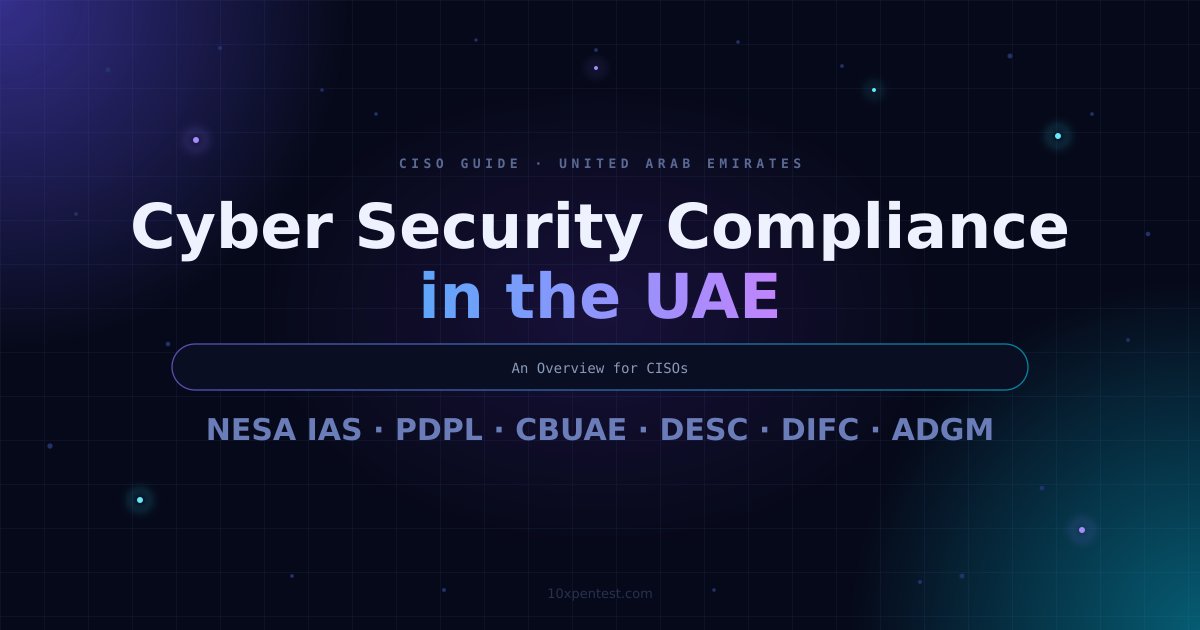
The UAE has built one of the most layered cybersecurity regulatory environments in the Middle East, and the complexity is not uniform. A CISO at a federal government entity faces a different primary framework than one at a DIFC-licensed investment firm, who faces a different set of obligations than one at an Abu Dhabi healthcare network. The frameworks overlap in some areas, diverge in others, and all of them treat penetration testing as a core security validation obligation rather than an optional practice.
Understanding which frameworks apply to your organisation, what each requires in concrete terms, and how they interact with each other is the prerequisite for building a compliance program that satisfies regulators rather than approximating them.
This guide maps the UAE cybersecurity compliance landscape across all major frameworks, identifies the penetration testing obligations each creates, and explains how modern security testing programs satisfy those obligations efficiently.
The UAE cybersecurity regulatory landscape
The UAE operates a multi-layered regulatory structure with federal frameworks governing critical infrastructure and data protection, sector-specific frameworks governing banking, healthcare, and telecoms, and free zone frameworks governing entities in DIFC and ADGM. Each layer has distinct legal authority and enforcement mechanisms.
Federal frameworks
NESA Information Assurance Standards (IAS)
The National Electronic Security Authority (NESA), now administratively consolidated into the UAE Signals Intelligence Agency (SIA), developed the Information Assurance Standards as the primary national cybersecurity framework. <cite index="11-1">The framework comprises 188 security controls covering both technical defences and organisational governance.</cite> <cite index="8-1">For compliance purposes, the standards organisations need to implement are the NESA IAS v2 controls, regardless of whether the enforcing authority is labelled NESA or the UAE Cybersecurity Council.</cite>
NESA IAS applies to federal government entities and organisations designated as Critical Information Infrastructure (CII) operators across energy, transport, telecoms, water, and financial services. For CII operators, compliance is mandatory. For private sector organisations, <cite index="11-1">NESA compliance is increasingly a strategic choice that signals trust, credibility, and readiness to operate in a market where digital risks are high.</cite>
The penetration testing obligation under NESA IAS is explicit. <cite index="13-1">The UAE IAS requires penetration testing at least annually, plus event-driven testing after major architectural changes. Results must be tracked through closure, not filed as PDFs.</cite>
Federal Decree-Law No. 34/2021 (Cybercrime Law)
The UAE Cybercrime Law establishes legal prohibitions and penalties for cybersecurity incidents including data breaches, unauthorised access, and cyber fraud. It applies to all entities operating in the UAE regardless of sector. <cite index="8-1">NESA non-compliance penalties are enforced under UAE Federal Decree-Law No. 34 of 2021 and sector-specific regulations.</cite> For organisations subject to NESA IAS, the Cybercrime Law creates the enforcement mechanism that makes non-compliance a legal rather than merely regulatory risk.
Federal Decree-Law No. 45/2021 (PDPL)
<cite index="10-1">The Federal Decree-Law No. 45 of 2021 on the Protection of Personal Data (PDPL) came into effect with its executive regulations published in 2023. It establishes a comprehensive data protection regime aligned with global standards while reflecting UAE legal traditions.</cite>
The PDPL imposes security obligations on all organisations handling personal data of UAE residents, including requirements for reasonable security arrangements, breach notification obligations, and data localisation requirements for certain data categories. Security testing is a component of demonstrating that reasonable security arrangements are in place.
Sector-specific frameworks
CBUAE Cyber Risk Framework
The Central Bank of the UAE has issued a Cyber Risk Framework specifically for licensed financial institutions including banks, insurers, payment service providers, and exchange houses. <cite index="13-1">The framework covers cyber-risk regulations for licensed financial institutions</cite> and requires regular security assessments, penetration testing, and board-level cyber risk reporting with KPIs demonstrating whether the security posture is improving or degrading.
For CISOs at UAE-licensed financial institutions, the CBUAE framework creates obligations that parallel and extend NESA IAS. An annual penetration test satisfies the minimum for both, but the CBUAE framework's emphasis on continuous risk monitoring and board-level reporting creates expectations for ongoing security validation that periodic testing alone does not satisfy.
DESC Information Security Regulation
<cite index="13-1">DESC covers Dubai government entities and selected sectors.</cite> The Dubai Electronic Security Centre Information Security Regulation governs government departments and entities operating under Dubai government supervision. For organisations that serve as technology or service providers to Dubai government entities, DESC requirements frequently flow into contractual and procurement obligations even where they are not directly legally applicable.
<cite index="14-1">DESC wants assurance that web application services are resilient to real attacks. A structured manual and automated web application penetration test scoped to the service and cloud footprint demonstrates resilience and uncovers misconfigurations that automated scans miss.</cite>
ADHICS
<cite index="13-1">ADHICS covers Abu Dhabi healthcare.</cite> The Abu Dhabi Healthcare Information and Cyber Security standard applies to healthcare entities operating in Abu Dhabi, including hospitals, clinics, insurance entities, and healthcare technology providers. It requires security controls across access management, network security, data protection, and periodic security testing. CISOs at healthcare entities operating in Abu Dhabi face a layered obligation: ADHICS for the healthcare-specific controls alongside NESA IAS for CII-designated entities and PDPL for personal health data.
TDRA cybersecurity obligations
<cite index="13-1">TDRA imposes cybersecurity obligations for telecommunications and digital service providers.</cite> The Telecommunications and Digital Regulatory Authority framework applies to licensed telecoms operators, internet service providers, and designated digital service providers. Annual penetration testing of core network infrastructure and customer-facing systems is a standard expectation under TDRA oversight.
Free zone frameworks
DIFC Data Protection Law 2020
The Dubai International Financial Centre operates its own legal jurisdiction with data protection rules modelled on GDPR. DIFC-licensed entities are subject to DIFC Data Protection Law 2020 rather than the federal PDPL, though the practical security obligations are similar: reasonable security measures, breach notification within 72 hours of discovery, and evidence of regular security testing as part of demonstrating security programme maturity.
Financial services firms licensed by the Dubai Financial Services Authority (DFSA) within DIFC face additional cybersecurity-specific requirements from DFSA itself, including regular penetration testing and incident response capability testing.
ADGM FSRA Cybersecurity Framework
The Abu Dhabi Global Market Financial Services Regulatory Authority has issued a Cybersecurity Framework for ADGM-licensed financial services firms. It operates similarly to the DIFC framework: own jurisdiction, GDPR-aligned data protection, and financial services-specific cybersecurity obligations including penetration testing requirements.
What UAE compliance requires from penetration testing programs
Across all the frameworks above, the penetration testing obligations share common characteristics while differing in specifics. A CISO designing a penetration testing program that satisfies the full landscape of applicable UAE frameworks needs to address the following.
Annual penetration testing as the baseline
Every UAE cybersecurity framework that addresses penetration testing explicitly specifies at minimum annual testing. NESA IAS makes this explicit for CII operators. CBUAE makes it explicit for licensed financial institutions. ADHICS makes it explicit for Abu Dhabi healthcare entities. The annual cadence is the floor, not the ceiling.
Post-change testing following significant deployments
<cite index="13-1">NESA IAS requires penetration testing at least annually plus event-driven testing after major architectural changes.</cite> This post-change obligation mirrors the MAS TRM requirement in Singapore and the proposed HIPAA Security Rule updates in the US, where regulators across jurisdictions are converging on the same position: periodic testing is insufficient when systems change continuously.
For organisations deploying frequently, satisfying the post-change testing obligation through manual engagement scheduling is operationally and economically challenging. Continuous penetration testing and how it differs from annual pentests covers how deployment-triggered agentic testing satisfies this obligation automatically.
<cite index="13-1">Results must be tracked through closure, not filed as PDFs.</cite> This is among the clearest statements in any UAE compliance document about what the testing obligation actually requires. A VAPT report is not the deliverable. The remediation tracking record (finding identified, fix deployed, retest confirming closure) is what regulators and auditors increasingly ask to see.
What is inside a VAPT report covers what a quality report contains and how the remediation documentation should be structured for regulatory review.
Scope coverage across the full attack surface
<cite index="14-1">Scope pen tests should include external (internet), internal (LAN), authenticated app tests, API tests, mobile app backend tests, and cloud configuration reviews. For payment flows include CDE-scope testing to meet PCI.</cite>
Many UAE penetration testing programs focus on external perimeter and web application testing without covering API layers, authenticated application surfaces, or cloud configuration security. These are exactly the surfaces where the most impactful vulnerabilities exist. What a real web application penetration test should cover maps the twelve coverage dimensions a complete assessment must address. API vulnerabilities standard penetration tests miss covers the eight API-specific classes that fall outside standard methodology.
Board-level reporting with continuous monitoring
The CBUAE framework explicitly requires board-level cyber risk reporting with KPIs demonstrating trend direction. A CISO who can only report "we conducted our annual pentest and found X findings" is providing point-in-time evidence rather than the continuous monitoring evidence that demonstrates genuine security programme maturity.
The gap most UAE compliance programs carry
Across the frameworks described above, the most common compliance gap is the same one that exists in Singapore under MAS TRM: the post-change testing obligation is acknowledged but not operationally addressed.
Organisations conduct their annual penetration test. They file the report. They work through the remediation list. Then they deploy new features, update infrastructure, and onboard new cloud services for the next eleven months without retesting. When the next annual pentest occurs, it tests an environment substantially different from the one that passed the previous assessment.
<cite index="8-1">NESA IAS has UAE-specific controls and reporting requirements not fully covered by ISO 27001, particularly around incident reporting to UAE authorities, sector-specific technical requirements, and the NESA annual penetration testing mandate.</cite> The interaction between the annual mandate and the post-change requirement means that ISO 27001 certification alone does not satisfy NESA's testing expectations for CII operators.
The security gaps standard penetration testing misses covers the ten specific categories of vulnerability that periodic engagement-based testing leaves open between assessments, which are directly relevant to the NESA post-change obligation.
How continuous agentic penetration testing addresses UAE compliance
Agentic pentesting and continuous security validation addresses the UAE compliance landscape's key obligations more efficiently than periodic manual engagements for three reasons.
Deployment-triggered testing satisfies the NESA post-change requirement automatically. When infrastructure changes, agents test the updated environment before the next deployment cycle, producing evidence that testing occurred following the change rather than eleven months later.
Automatic remediation retesting satisfies the tracked-closure requirement across all UAE frameworks. Findings are not closed on the CISO's assertion: they are closed when the system confirms the exploit path is no longer viable, producing timestamped evidence that satisfies TDRA, CBUAE, and DESC auditor expectations.
Continuous evidence generation satisfies the board-level monitoring requirement in the CBUAE framework. Instead of producing an annual point-in-time risk report, the security program generates a continuous record of security posture trends that supports the KPI-based board reporting the CBUAE framework expects.
How autonomous pentesting produces a continuous compliance evidence record covers the operational model for UAE-regulated organisations considering the shift from periodic to continuous testing.
For UAE-based organisations seeking VAPT services in the UAE, PTaaS in the UAE, or agentic penetration testing in the UAE, the 10x Pentest platform is built for the continuous model. See pricing or get in touch to discuss mapping your program against UAE compliance requirements.
Frequently asked questions
Q1. Is penetration testing mandatory in the UAE?
Yes, for several categories of organisation. NESA IAS mandates annual penetration testing for federal government entities and Critical Information Infrastructure operators. The CBUAE Cyber Risk Framework mandates it for licensed financial institutions. ADHICS mandates it for Abu Dhabi healthcare entities. TDRA obligations include it for telecoms and digital service providers. DIFC and ADGM frameworks require it for licensed financial services firms. For private sector organisations not falling under these categories, NESA IAS is technically advisory rather than mandatory, but it is referenced in government procurement requirements, supplier questionnaires, and regulatory examinations across sectors, making compliance a practical necessity for organisations with significant government or regulated-sector relationships.
Q2. What is NESA and what does it require from a security testing perspective?
NESA (the National Electronic Security Authority, now administratively part of the UAE Signals Intelligence Agency) developed the Information Assurance Standards that serve as the UAE's national cybersecurity baseline. The IAS v2 comprises 188 security controls covering technical and management domains. From a security testing perspective, NESA IAS requires annual penetration testing of critical systems, event-driven testing following major architectural changes, vulnerability management with documented remediation tracking, and evidence that testing results are closed rather than merely filed. The standard differentiates between vulnerability scanning and penetration testing and requires the latter for critical systems.
Q3. How do DIFC and ADGM cybersecurity requirements differ from federal UAE requirements?
DIFC and ADGM operate as separate legal jurisdictions with their own regulatory bodies and legal systems. DIFC Data Protection Law 2020 and ADGM FSRA Cybersecurity Framework each apply to entities licensed in their respective free zones in place of federal PDPL, though the practical security obligations are similar. Entities operating in DIFC or ADGM are generally not directly subject to NESA IAS unless they also operate as CII operators or have other federal obligations, but DFSA and FSRA examination practice references security testing standards consistent with NESA IAS expectations. Entities with operations both inside and outside the free zones may face layered obligations under both federal and free zone frameworks.
Q4. What does "tracked through closure" mean for UAE VAPT compliance?
The NESA IAS and CBUAE framework requirement that penetration testing results be tracked through closure means the organisation must demonstrate not just that testing was conducted and findings were identified, but that each finding was remediated and that remediation was confirmed through retesting before the finding was marked closed. A penetration test report submitted without a companion remediation tracking document showing finding status, remediation dates, and retest confirmation does not satisfy this standard. Regulators and auditors asking to see the "penetration testing evidence" in a UAE compliance examination are asking for both the initial report and the remediation closure record.
Q5. How often should penetration testing be conducted to satisfy UAE compliance requirements?
Annual testing satisfies the minimum frequency specified by most UAE frameworks for standard systems. NESA IAS additionally requires testing following significant architectural changes, which means the effective frequency for actively developing organisations is higher than once per year. The CBUAE framework's emphasis on continuous monitoring suggests that the trajectory of regulatory expectation is toward more frequent testing, consistent with global trends in financial services cybersecurity regulation. For CISOs building programs that satisfy current requirements and position ahead of tightening expectations, continuous penetration testing aligned to deployment cadence is the model that satisfies both the annual minimum and the post-change obligation simultaneously.


 Tejas Dhokane Sep 18, 2026